Short answer: the UDR-5G-Max is a UniFi Dream Router with 5G built in, so it can run a site on mobile broadband as the primary connection or fail over to it automatically when fixed-line internet drops. It suits sites with no NBN, temporary and pop-up sites, and any location where an outage is expensive. It runs full UniFi OS, so network, Wi-Fi and Protect cameras are managed from one console.
The short version: the UDR-5G-Max is the only UniFi gateway with a built-in full-performance 5G modem, and it supports every 5G and 4G band Australian carriers actually use. If you need a site running on cellular — as its primary link or as automatic failover — this is the box. If you have solid fixed-line internet, the UDR7 gives you the same networking for less.
A note on what this is: we are an authorised Ubiquiti reseller, and this analysis is based on Ubiquiti's published specifications, the realities of Australian mobile networks, and our experience deploying UniFi gateways. It is not a lab benchmark, and we have not published speed test figures we did not measure.
What the UDR-5G-Max is
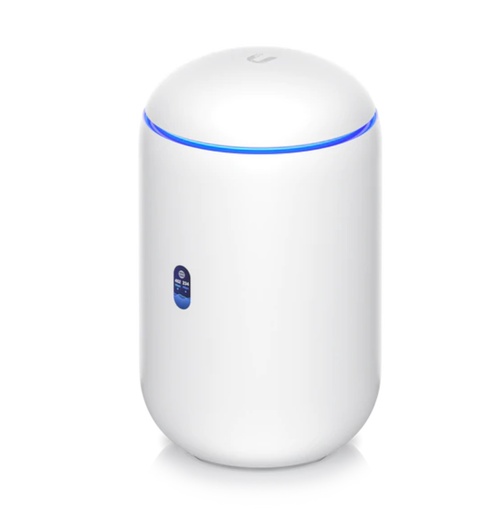
The UniFi Dream Router 5G Max is a desktop cloud gateway with a 5G modem built in. In a single cylindrical unit roughly 110 mm square and 250 mm tall you get a router, firewall with IDS/IPS, a WiFi 7 access point, a four-port 2.5 GbE switch, the UniFi network controller, and a small UniFi Protect recorder.
Plenty of routers accept a USB dongle or treat mobile as an emergency trickle. This is a different proposition: a proper 5G modem with dual SIM slots and HPUE power class 2 output, built to carry a site's entire internet connection indefinitely.
Australian carrier compatibility
This is where most imported 5G hardware falls over, so it is worth checking properly. The UDR-5G-Max supports every band in commercial use on Australian networks.
| Band | Used by | Supported |
|---|---|---|
| n78 (3500 MHz) — primary 5G | Telstra, Optus, Vodafone | Yes |
| n5 (850 MHz) — 5G DSS | Telstra | Yes |
| n28 (700 MHz) — low-band 5G | Optus, Vodafone | Yes |
| n1 (2100 MHz) / n40 (2300 MHz) | Various | Yes |
| B3 (1800 MHz) / B28 (700 MHz) — 4G | Telstra, Optus, Vodafone | Yes |
Full 5G NR support runs n1, n2, n3, n5, n7, n8, n12, n13, n14, n18, n20, n25, n26, n28, n29, n30, n38, n40, n41, n48, n66, n70, n71, n75, n76, n77, n78 and n79 — comfortably more than Australia needs.
What 3.4 Gbps actually means
Ubiquiti quotes 3.4 Gbps downlink and 560 Mbps uplink on 5G NSA, 1.8 Gbps down and 650 Mbps up on 5G standalone, and 1.6 Gbps down on 4G LTE.
Those are theoretical maximums under ideal conditions with full carrier aggregation. What you will actually see depends on which bands your carrier has lit at your address, how strong the signal is, how far you are from the tower, and how many other people are on that cell at the time. Treat the number as headroom — it means the modem will not be your bottleneck — not as a speed you should expect.
The more useful figure for most buyers is HPUE power class 2, giving 26 dBm on 5G. Higher transmit power translates to a more usable connection at the edge of coverage, which is exactly where sites that need a 5G router tend to be.
The hardware, port by port
The rear panel is straightforward:
- Two nano-SIM slots marked NANO SIM 1 and NANO SIM 2
- Four 2.5 GbE RJ45 ports. Port 1 supplies PoE (15.4W budget); port 4 is a default WAN
- One 10G SFP+ port (port 5), the other default WAN
- Ventilation running the length of the rear face — it is fanless
Underneath sits the microSD slot, the 54V DC input and a recessed reset button. The front carries a 4.7-inch touchscreen showing cellular signal and RSRP, data usage against your plan, internet throughput, WiFi experience, client count and port status. On a cellular device that screen earns its place — you can see signal strength while you move the unit around rather than guessing.
Internals are a quad-core ARM Cortex-A53 at 1.5 GHz with 3 GB of memory, in a polycarbonate enclosure weighing 1.4 kg, rated 0 to 40°C.
Everything built into the box
| Function | Capability |
|---|---|
| Routing & firewall | 2.3 Gbps IDS/IPS, 20,000+ signatures with CyberSecure |
| WiFi | WiFi 7, 2x2 MU-MIMO, ~160 m² coverage |
| Switching | 4 x 2.5 GbE (1 PoE) + 1 x 10G SFP+ |
| UniFi controller | 30+ managed UniFi devices |
| Camera recording | 5 HD / 2 2K / 1 4K, 64 GB microSD included |
| VPN | Site Magic 20, WireGuard 8, OpenVPN 8 |
| Clients | 300+ simultaneous |
For a single-box site that is a lot of ground covered without a rack, a patch panel or a separate controller.
Shopping for UniFi routers?
Authorised Ubiquiti reseller: genuine Australian stock, full warranty, competitive prices and price match available.
Where it makes the most sense
No fixed line yet
New premises or rural sites where the NBN connection is months away. Run the whole site on 5G from day one.
Automatic failover
Fibre on the SFP+ WAN, 5G as backup. When the line is cut, the site stays up unattended.
Temporary sites
Construction offices, events, pop-up retail and display suites — full UniFi that packs down and moves.
It also suits remote and regional offices managed centrally from the same UniFi console as the rest of the estate, and replacing a carrier-supplied modem with something that has a real firewall, VLANs and VPN.
UDR-5G-Max vs UDR7 vs UCG-Max
| UDR-5G-Max | UDR7 | UCG-Max | |
|---|---|---|---|
| Built-in 5G | Yes | No | No |
| Built-in WiFi | WiFi 7 | WiFi 7 | No |
| IDS/IPS throughput | 2.3 Gbps | 2.3 Gbps | 2.3 Gbps |
| Clients | 300+ | 300+ | 300+ |
| 10G SFP+ | Yes | Yes | No |
| Indicative price | ~$899 | ~$539 | ~$459 |
All three run the same 2.3 Gbps inspection engine and the same client capacity, so the real decision is cellular, built-in WiFi and the 10G uplink. Need a rack-mount unit with drive bays instead? See the UDM Pro Max, our cloud gateway comparison, the Dream Machine comparison and the rack-mount gateway guide.
Choosing a SIM and data plan
The router is only half the equation. A site running entirely on 5G will move far more data than a phone, so the plan matters more than the hardware.
- Check coverage at the address, not the suburb. Carrier maps vary street by street, particularly for n78, which does not travel far.
- Watch for data caps and shaping. Some "unlimited" mobile broadband plans shape hard after a threshold, which is fine for a backup link and painful for a primary one.
- Use both slots. Two carriers in the two SIM slots gives genuine redundancy — outages tend to affect one network at a time.
- Consider CGNAT. Most mobile plans put you behind carrier-grade NAT, so inbound connections and site-to-site VPN need planning. UniFi's Site Magic handles the common cases.
Getting the best signal
This is the single biggest determinant of how well the unit performs, and it costs nothing to get right.
The UDR-5G-Max relies on internal antennas, so put it in the open. A steel comms cabinet, a concrete riser or a basement will cost you signal and there is no way to recover it in software. Higher is generally better, and closer to a window better still. Use the touchscreen: it shows live RSRP, so you can walk the unit around the site and watch the number improve rather than guessing.
Remember the 0 to 40°C operating range too. A closed cupboard in an Australian summer can exceed that.
The verdict
The UDR-5G-Max occupies a genuinely useful niche. It is the only UniFi gateway with real 5G built in, its band support covers every Australian network, and it collapses a router, firewall, WiFi 7 AP, switch, controller and small NVR into one desktop unit.
It is the obvious choice when cellular is part of the design — whether that is a site with no fixed line, a business that cannot afford an outage, or a temporary deployment that has to be running this week. Where fixed-line internet is reliable and failover is not a requirement, the UDR7 delivers the same networking without the cellular premium.
Why buy your Ubiquiti from ARC IP Networks: we are an authorised Ubiquiti reseller in Australia — genuine Australian stock, full manufacturer’s warranty and local support, not grey import. We hold stock others are waiting on, quote project pricing on multi-unit jobs, add UI Care where it is supported, and price match on genuine gear. Call 1300 100 440 or order at arcip.com.au.
Ready to buy?
Shop genuine Ubiquiti at ARC IP Networks
Authorised Ubiquiti reseller
Ubiquiti at ARC IP Networks
UniFi gateways, switches, Wi-Fi, Protect cameras and Access. Genuine Australian stock with the full manufacturer's warranty, competitive prices and price match available.
Frequently asked questions
Yes. It supports n78 (3500 MHz), the primary 5G band for all three Australian carriers, plus n5 used by Telstra, n28 used by Optus and Vodafone, and the 4G bands B3 and B28 that all three rely on.
It comes down to whether you need cellular. Both run the same 2.3 Gbps IDS/IPS engine, both have WiFi 7 and a 10G SFP+ port, and both handle 300+ clients. The UDR-5G-Max adds the 5G modem and dual SIM slots. If your site has reliable fixed-line internet and no failover requirement, the UDR7 delivers the same networking for less.
No. 3.4 Gbps is the theoretical maximum for 5G NSA under ideal laboratory conditions with full carrier aggregation. Real-world throughput depends on which bands your carrier has deployed at your location, your signal strength, and how congested the cell is. Treat it as headroom rather than an expected speed.
No. It is a Sub-6 device covering n1 through n79. In the small number of Australian locations with mmWave, it will connect on Sub-6 instead.
The rear panel has two physical slots marked NANO SIM 1 and NANO SIM 2. Ubiquiti's specification lists (2) Nano SIM and (1) Nano-SIM or eSIM, so you can run more than one carrier for redundancy.
Yes. Connect the fixed line to the 10G SFP+ or a 2.5 GbE WAN port and the gateway will switch to cellular automatically when the primary connection drops.
Yes, WiFi 7 with 2x2 MU-MIMO on all three bands — up to 5.7 Gbps on 6 GHz, 4.3 Gbps on 5 GHz and 688 Mbps on 2.4 GHz — covering roughly 160 square metres.
On a small scale. It ships with a 64 GB microSD card and runs UniFi Protect for five HD, two 2K or one 4K camera. Larger camera counts need a dedicated recorder.
One of the four 2.5 GbE ports provides PoE with a 15.4W budget, enough for a single 802.3af device such as an access point or camera.
No. UniFi has no subscription or licensing costs. Your only recurring expense is the mobile data plan.
ARC IP Networks lists it at $899 including GST at the time of writing. Check the product page for current pricing.
It handles 300+ simultaneous clients and 30+ managed UniFi devices, with WiFi covering about 160 square metres. For larger areas, add UniFi access points and let the gateway route.

Who we are
About ARC IP Networks
ARC IP Networks is an Australian supplier of networking, Wi-Fi and gateway equipment, based in Blackburn, Melbourne, Victoria. We work with homeowners, installers, integrators and businesses across Australia, supplying Ubiquiti UniFi, MikroTik, TP-Link, Ruijie, Teltonika and D-Link.
We are an authorised Ubiquiti, MikroTik, TP-Link, Ruijie, Teltonika and D-Link reseller, so you get genuine Australian stock with the full manufacturer's warranty, never grey imports, at competitive prices. Our team can help you choose the right equipment, and trade customers get trade accounts and project pricing on larger jobs.
- Genuine Australian stock with the full manufacturer's warranty
- Competitive prices, price match available
- Trade accounts for installers, integrators and MSPs
- Australia-wide delivery; showroom in Blackburn, Mon–Fri 9–5 (demos by appointment)
Need help choosing?
Tell the ARC IP Networks team what you are trying to achieve and we will recommend the right equipment and quote it as one order.